
Is Content Marketing Still Effective for SMBs in the AI Era?
Last updated

Table of Contents
Earlier this year, a B2B service client asked us this exact question during our strategy review. We’d just finished discussing their SEO performance, and the results, let’s just say, were not fantastic.
Their organic traffic had been trending down since late 2024, and we knew exactly why – Google’s AI Overviews were “stealing” clicks from their first-page rankings. We’d already helped them understand that dynamic and put countermeasures in place.
But this question made us pause. If AI is disrupting search traffic, what’s it doing to content marketing as a whole?
Content is No Longer King, It’s Become a Commoner
“Content isn’t king anymore, at least not for SMBs like us,” our client exclaimed. “I feel like content has become… a commoner.” We all laughed, because it rings so true.
Plenty of data backs this up. To quote a few figures:
- In the 15 months after ChatGPT was released, AI-generated content surged 8,362% across the web, according to Copyleaks – an AI detection company that analyzed 1 million web pages from the common crawl dataset.
- By March 2024, 1.57% of all web pages contained AI-generated content. That might sound small, but it’s actually massive considering the speed at which it happened.
Now consider that 93% of marketers report using AI for faster content creation, you can see how quickly marketing content is becoming saturated. If you feel like your content is shouting into the void lately, there is a reason.
Even established media companies are seeing massive drops due to AI. HuffPost lost over 50% of its organic search traffic in three years. The Washington Post saw nearly identical declines. Business Insider’s traffic dropped 55%, forcing them to cut 21% of their staff. If billion-dollar media companies with decades of authority can’t compete in this landscape, what chance do SMBs have with traditional content strategies?
We promised our client we’d think deeper about content strategy before our next session. Here’s what we discovered.
The Death of the 3E Trilogy
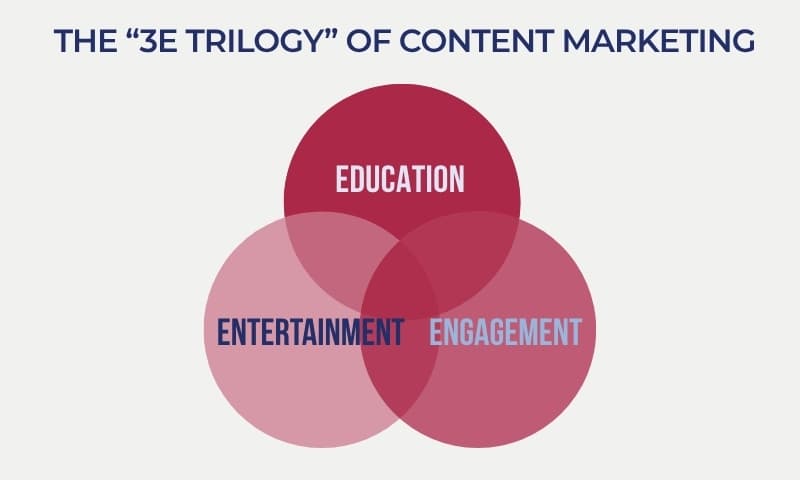
Traditional content marketing relied on a framework called the “3E trilogy”: Education, Entertainment, and Engagement. Effective content aims to achieve at least one, or ideally two, of the Es. For B2B companies, this usually meant educational content designed to engage prospects and support SEO.
But AI has disrupted this model:
- Education is no longer your content differentiator. AI has become the greatest educator of all time – instantly accessible, infinitely patient, and constantly improving. When your B2B prospects have questions, they’re increasingly turning to AI tools. When they search on Google, AI overviews often resolve their query without the need to visit your blog posts.
- Entertainment isn’t relevant for B2B. Your prospects aren’t looking to be entertained by your content. They’re looking for solutions to business problems.
- Engagement is plummeting. First-page rankings don’t guarantee engagement and clicks anymore. On SEO, Google’s AI Overviews are answering questions directly, eliminating the need to click through to your site.
So if education, entertainment, and engagement are no longer reliable, what is?
The Thought Leadership Trap
Every B2B marketing agency seems to recommend “thought leadership content” as a content strategy at some point, us included. It sounds appealing – publish insights, be seen as an authority, attract top-tier clients. But here’s what we learned the hard way – thought leadership is overrated for SMBs.
- It requires resources most SMBs don’t have, or can’t sustain in the long term.
- B2B customers care more about whether you can solve their problems than whether you’re a thought leader.
- Most thought leadership content is generic and derivative rather than truly helpful to customers who need B2service.
- It takes years to build meaningful authority in competitive markets.
What your customers actually care about is much more straightforward: Can you help me? Do you understand my specific situation? Do I trust you to deliver results? Content and actions that answer these questions convert prospects into clients better than any SEO-optimized thought leadership piece.
What’s Changed vs. What Hasn’t for Content in the AI Age
As we brainstormed our updated B2B content marketing playbook, we asked various AI tools using different types of prompts. To our surprise (and frustration), they all gave us the exact same advice – “build thought leadership content.” Every single one! Even in 2025, AI still pushes the same tired advice that we know doesn’t work for most SMBs.
It made us realize that while AI can create content, it can’t yet understand the nuanced realities of B2B marketing. This insight became the foundation of our AI-era content marketing approach. The rise of AI has caused changes and disruptions, but a lot remains constant.
What Has Changed
- Anyone can produce decent-looking content with AI tools
- The content marketing space is saturated with generic, AI-generated articles
- Your B2B prospects are increasingly ignoring generic content and skeptical of AI-generated content
- Google and generative AI tools are providing direct answers, reducing your SEO click-through rates
- Content distribution channels are more fragmented than ever
What Hasn’t Changed
- People still buy from businesses they trust
- B2B leads still require nurturing due to the long sales cycle, content remains an effective tool for this
- Complex B2B decisions still require human insight and expertise that AI can’t yet provide
- Authentic, specific experiences can’t be replicated by AI
- Content still drives business when it serves a specific purpose in your sales process
- Content creation is only part of content strategy, other important parts include distribution, amplification, and integration. The king has always been going around with an entourage, not by himself.
The key insight is: content marketing goals haven’t changed, B2B sales processes haven’t changed, but how we use content marketing to support B2B sales must evolve dramatically.
Content Marketing in AI Era: Our ADA Framework
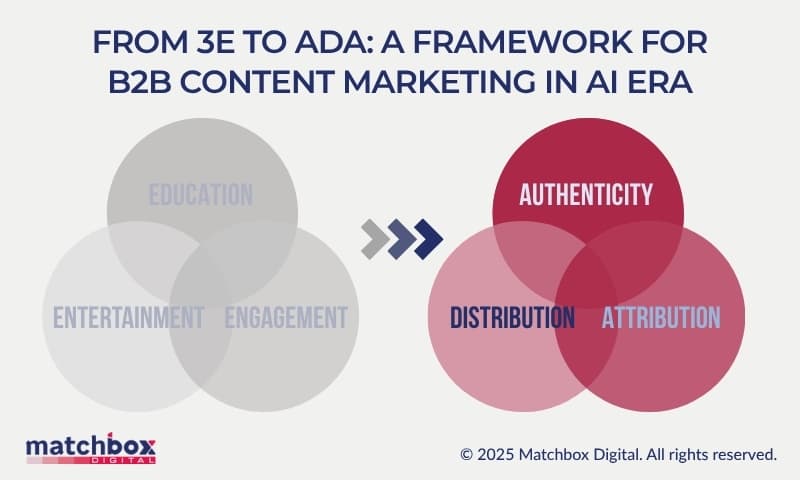
Here’s the reframed approach we developed to help B2B businesses evolve their content strategy for the AI era, including the client who posed that hard but invaluable question. Instead of chasing the content creation hamster wheel, we identified three strategic pillars that actually move the needle.
1. Authenticity Over Polish, Quality Over Quantity
AI can create polished expert-sounding content, but it can’t replicate the nuanced, real-world knowledge you’ve gained from solving actual problems for specific clients. This type of expertise sets your content apart from AI output. So focus on creating content that demonstrates:
- How you actually solve problems (not generic best practices)
- Specific client outcomes with detailed context (where disclosure is appropriate)
- Your decision-making process for complex situations
- Unique insights and point of view from your industry experience
2. Distribution over Creation
Content without distribution is like having a brilliant conversation in an empty room. It is pointless and wasteful, no matter how good. A “lonely king”, as our client called it. This principle isn’t new, but with AI-generated content flooding the market and AI-powered search taking over Google, it’s more critical than ever. Even quality content can disappear into Google’s “no man’s land,” wasting your resources.
Focus on strategic distribution:
- Multi-channel repurposing of existing content
- Building strategic partnerships for additional distribution reach
- Direct outreach to prospects using content as conversation starters
3. Attribution That Supports Conversion
Third-party cookie deprecation and AI search have disrupted how we attribute conversions using the traditional Awareness-Interest-Desire-Action (AIDA) model. You can’t rely on simple impression-to-click-to-conversion tracking anymore. Instead, track what connects to actual business outcomes – sales qualified leads (SQLs), closed deals, new customers.
For content marketing, measure and attribute:
- Content’s influence on sales conversations
- Lead quality trends from content engagement
- Revenue influenced by content interactions
- Content’s share of total acquisition costs
This also serves as crucial input for your Customer Acquisition Cost (CAC) calculation. Without measuring content’s contribution to customer acquisition, you are flying blind on ROI.
Applying ADA to Your Content Strategy
The shift from Education-Entertainment-Engagement to Authenticity-Distribution-Attribution is about rethinking how content fits into your customer acquisition strategy. Content marketing can still be a powerful growth driver for SMBs in the AI age, but only when it addresses what AI can’t: authentic expertise, strategic distribution, and meaningful attribution.
Done right, this becomes your competitive advantage in an AI-saturated market.
Ready to Build a Content System that Actually Drives Sales?
As a growth-focused digital marketing agency, we help B2B companies implement the ADA framework to create content strategies that generate qualified leads, support longer sales cycles, and deliver measurable ROI. Instead of chasing vanity metrics, we focus on the metrics that matter: customer acquisition and revenue growth. If that sounds like you, let’s talk.
Don’t wait for change. Drive it!
Get ahead of industry shifts with proven strategies. Schedule your complimentary 30-minute consultation today.